Many access control products reach a point where the core system still works, but customers want mobile credentials, remote administration, cloud management, stronger reader-to-controller security or easier multi-site control. Replacing every reader, controller, credential and cable can be expensive and disruptive.
Access control modernisation is the process of adding newer capabilities while retaining compatible parts of the existing system where practical. A project might keep door hardware and cabling, replace selected readers, update controller firmware, introduce cloud connectivity and migrate users gradually.
For access control companies, the main challenge is deciding what can stay, what can be adapted and what genuinely needs replacement. This article explains how to assess that decision, plan a legacy access control upgrade and reduce the operational risk of moving customers toward mobile and cloud features.

Start with the existing access control estate
An access control system upgrade should start with the installed estate, not the target feature list.
Document what is already deployed: readers, controllers, interface modules, credential technologies, wiring, power supplies, firmware versions, locks, door sensors, management software and connected systems such as HR or visitor-management platforms.
Age alone does not decide what should be replaced. Some older hardware may still meet the new requirements. Other components may open doors reliably but block stronger communication protocols, mobile credentials, remote updates or vendor support.
The table below helps separate those decisions.
|
Existing component |
What to assess |
Possible outcome |
|
Readers |
Credential and protocol support |
Keep, reconfigure or replace |
|
Controllers |
Firmware, interfaces, capacity and offline behaviour |
Keep, bridge or replace |
|
Cabling |
Type, condition and protocol compatibility |
Reuse where compatible |
|
Credentials |
Security and reader compatibility |
Retain temporarily or migrate |
|
Cardholder data |
Formats, duplicates, access groups and schedules |
Clean, map and migrate |
|
Integrations |
APIs, directories and third-party systems |
Reconnect, rebuild or retire |
Also identify equipment that is unsupported or approaching end of life. A component may be technically reusable but still create a support problem if parts, firmware updates or vendor assistance are no longer available.
Consider a six-floor office building with 40 access-controlled doors. Of these, 30 readers already support card and mobile credentials, while the remaining 10 use older proximity-card technology. The controllers are still supported, and the existing wiring is in good condition.
The building could retain the 30 compatible readers and replace only the 10 older units. The controllers and wiring could also remain, provided compatibility testing confirms they support the planned upgrade. This would reduce hardware costs and installation work compared with replacing the entire system.
Decide what can stay, what can be adapted and what must change
After the assessment, divide the system into three groups: reuse, adapt and replace.
Reuse applies to components that already support the target architecture. Adapt applies where a firmware update, protocol converter, gateway or cloud-managed appliance can extend existing hardware. Replace applies where a component cannot meet the required security, compatibility or support requirements.
The Security Industry Association (SIA) notes that when moving from Wiegand to the Open Supervised Device Protocol (OSDP), existing mounting hardware, power infrastructure and even cabling can often be reused, although cabling still needs validation. OSDP is a reader-to-controller communication standard that supports bidirectional communication and a protected Secure Channel mode.
“Often, existing mounting hardware, power infrastructure, and even cabling can be reused.”
Security Industry Association
Hybrid cloud products can follow the same principle. Genetec, for example, documents cloud-managed appliances that connect existing access control devices to cloud services while keeping selected processing and storage functions at the edge.
The product team still needs a clear target architecture. Reusing hardware that preserves an unwanted limitation defeats the point of the upgrade.
Add mobile credentials in stages
A mobile access retrofit introduces another migration problem: users do not all need to move from cards to phones on the same day.
A mobile credential allows a compatible phone or wearable to act as an access credential. Depending on the ecosystem, the reader may use Bluetooth Low Energy (BLE), Near Field Communication (NFC), or both. BLE is a low-power wireless technology. NFC is a short-range technology commonly used for tap interactions.
During migration, multi-technology readers can support old and new credentials together. HID's current Signo readers, for example, support mobile credentials alongside several physical credential technologies and support both OSDP and Wiegand interfaces.
That coexistence period needs an end date. HID's guidance for migration-ready readers says legacy credential support should be disabled once migration is complete because the weaknesses associated with those older credentials remain while they are accepted. HID also recommends setting a hard cut-off date for migration mode.
For product teams, dual-technology support works well as a migration tool. The final state should match the security level the modernisation project was meant to achieve.
Cloud access control migration can be gradual
Moving management functions to the cloud does not require every site to change architecture at once.
An existing product can broadly move through three models:
- On-premises: management software and most system functions remain within the customer's local environment.
- Hybrid: local controllers or appliances keep selected functions while cloud services add central management, remote administration or new applications.
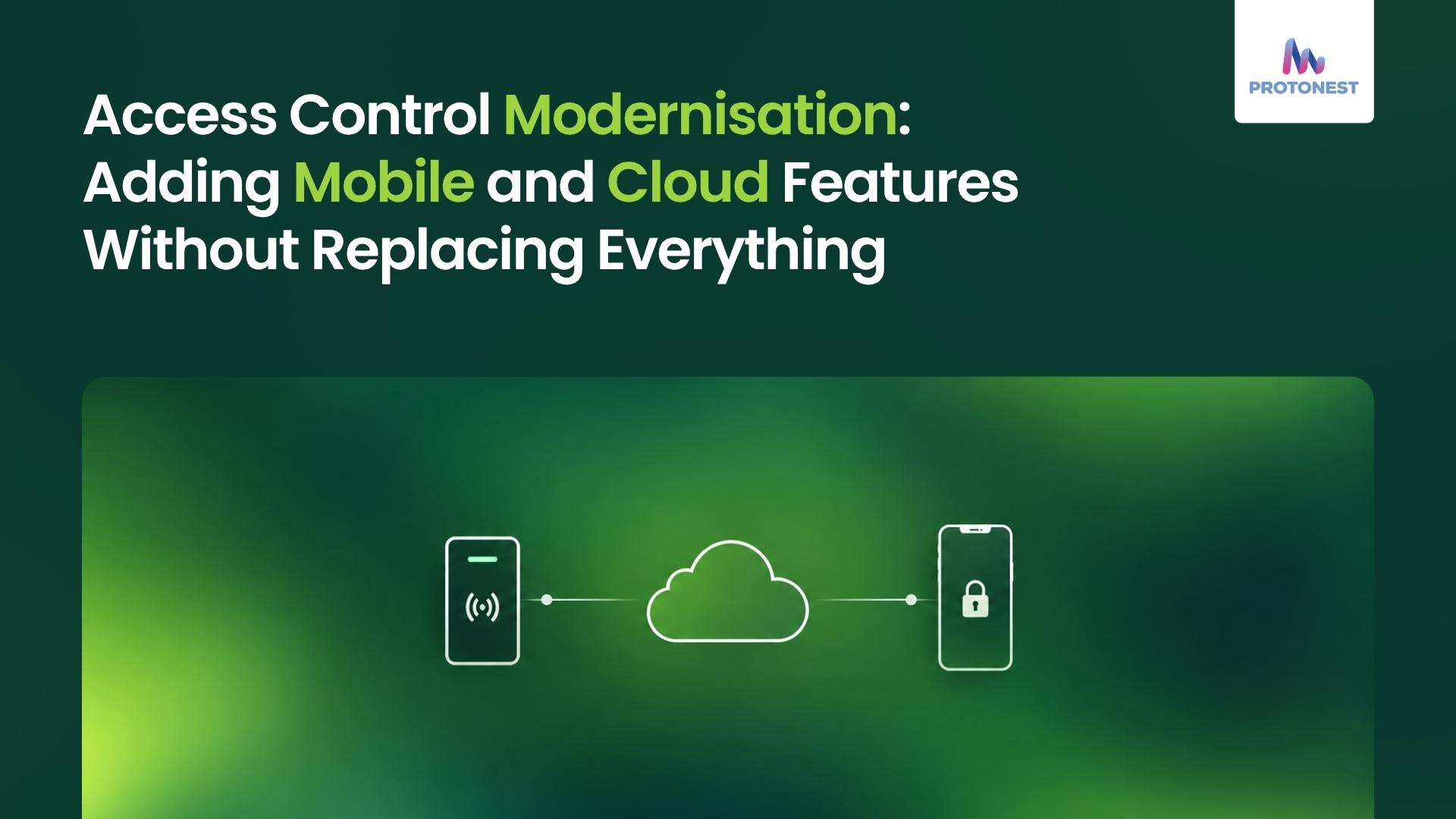
- Cloud-managed or cloud-native: more of the management platform is delivered through provider-managed cloud services, while door-level hardware still performs local tasks required by the product.
Hybrid deployment can be useful when the installed base still has value. Genetec's Synergis Cloud Link, for example, connects supported on-premises controllers and devices to hybrid or cloud deployments. SIA has also described modernisation projects where cloud-managed platforms extend existing infrastructure instead of forcing an immediate replacement.
For a cloud access control migration, define which functions remain local, which move to the cloud, how devices authenticate, which integrations must change and how updates will be managed.
Cloud management still needs an offline plan
Cloud management should not make a working door depend on a perfect internet connection.
A common approach is to keep the access information needed for normal door operation on the local controller. If cloud connectivity is lost, the controller can continue using its last downloaded configuration and store events until the connection returns.
Verkada documents controllers that continue operating from their last known cloud configuration during an internet outage, store events locally and synchronise when connectivity returns. Brivo similarly documents local access decisions from the last downloaded configuration when connectivity is unavailable.
These examples do not define every product architecture. They highlight the questions a product team needs to answer:
- Which credentials and permissions are stored locally?
- What happens to a credential revoked while a controller is offline?
- How long can events be stored?
- Which schedules continue to work?
- What happens when connectivity returns?
- Which remote functions become unavailable?
Offline behaviour should be defined as part of the product architecture before the migration begins.
To understand how this affects daily operations, consider an office building that loses internet connectivity at 8 AM. Employees whose access permissions are stored locally on the controllers can still enter using their existing credentials.
However, changes made during the outage may not reach those controllers. A new employee added at 9 AM might be unable to enter until connectivity returns. Similarly, an employee whose access is revoked during the outage could still enter if their previous permissions remain active locally.
Access control systems need clear rules for handling these situations. Depending on the security requirements, certain doors may need backup connectivity, such as 4G, or a way to update permissions locally during an outage.
Treat data migration as its own workstream
A legacy access control upgrade also involves data.
An existing platform may contain cardholder records, credential identifiers, access groups, schedules, door definitions, badge formats, custom fields and links to external identity systems.
Start by mapping the old data model to the new one. Identify duplicate and inactive users, check credential formats, validate access groups and decide which historical data needs to move.
Genetec's current Security Center documentation, for example, supports importing cardholders and credentials from CSV files. That is a vendor-specific implementation, but it illustrates the broader need for a defined method to transfer and validate identity and credential data.
Privacy also belongs in this workstream. SIA's access-control privacy guidance calls for controls such as role-based access, encryption and privacy considerations across the product's in-service life. Migration files can contain sensitive identity and access information, so access to them should be limited and temporary copies handled under the organisation's data policies.
Roll out the access control retrofit in stages
A staged rollout limits how much of the installed estate is affected by one change.
- Select a representative pilot site or door group.
- Test the proposed reader, controller, credential and cloud combination.
- Run old and new credentials together where required.
- Test normal operation and network-loss behaviour.
- Validate migrated cardholders, permissions and schedules.
- Record support issues from the pilot.
- Expand the deployment in controlled groups.
- Disable temporary legacy compatibility after migration.
Before each stage, define the rollback path. That might mean backing up databases and configuration, retaining the previous controller configuration, keeping old credentials active for an approved transition period or having replacement hardware ready for a failed pilot.
The rollback plan also needs a decision point. Teams should know what conditions trigger it and who can make that call.

Plan support before retiring the legacy system
Modernisation creates a period where different generations of hardware, credentials and software may coexist.
Support planning should define the combinations the company will officially support. Document compatible reader and controller versions, firmware requirements, mobile credential onboarding, diagnostics, update responsibilities and end-of-life dates.
Temporary compatibility modes need retirement dates too. HID recommends a hard cut-off date for migration mode and disabling it after all credentials have moved. The same principle applies more broadly: temporary compatibility should not quietly become the permanent architecture.
Questions to ask before an access control system upgrade
Before approving the migration plan, product and management teams should be able to answer:
- Which installed components remain supportable?
- Which components block the new mobile, cloud or security requirements?
- Can existing readers, controllers, wiring or door hardware be reused?
- Can old and new credentials coexist during migration?
- When will legacy credential support be disabled?
- Which access functions continue during an internet outage?
- What identity and access data needs to move?
- Can the migration be piloted on a limited set of doors or sites?
- What conditions trigger rollback?
- Who supports the mixed environment during the transition?
- What does the final architecture look like after legacy components are retired?
Modernise from the installed estate
Access control modernisation works best when the target architecture starts from a clear understanding of the existing estate.
A good upgrade may keep some door hardware and cabling, replace selected readers, update controllers, add mobile credentials and connect sites to cloud management in stages. The right combination depends on compatibility, security, support life and operational requirements.
The aim is a controlled path from the current product to the required capabilities, with temporary compatibility removed once it has served its purpose.
References
Security Industry Association, Implementing OSDP Access Control? Follow This Simple Checklist
Security Industry Association, From Legacy Systems to Modern Functionality
Security Industry Association, Data Privacy Code of Practice – Access Control
HID, HID Signo Readers in White
HID, Safeguarding Against Legacy Technology
Genetec, Cloud-Managed Appliances
Genetec, Importing Cardholders and Credentials
Verkada, Verkada Access Offline Operation
Brivo, Security Management System for Centralized Operations